
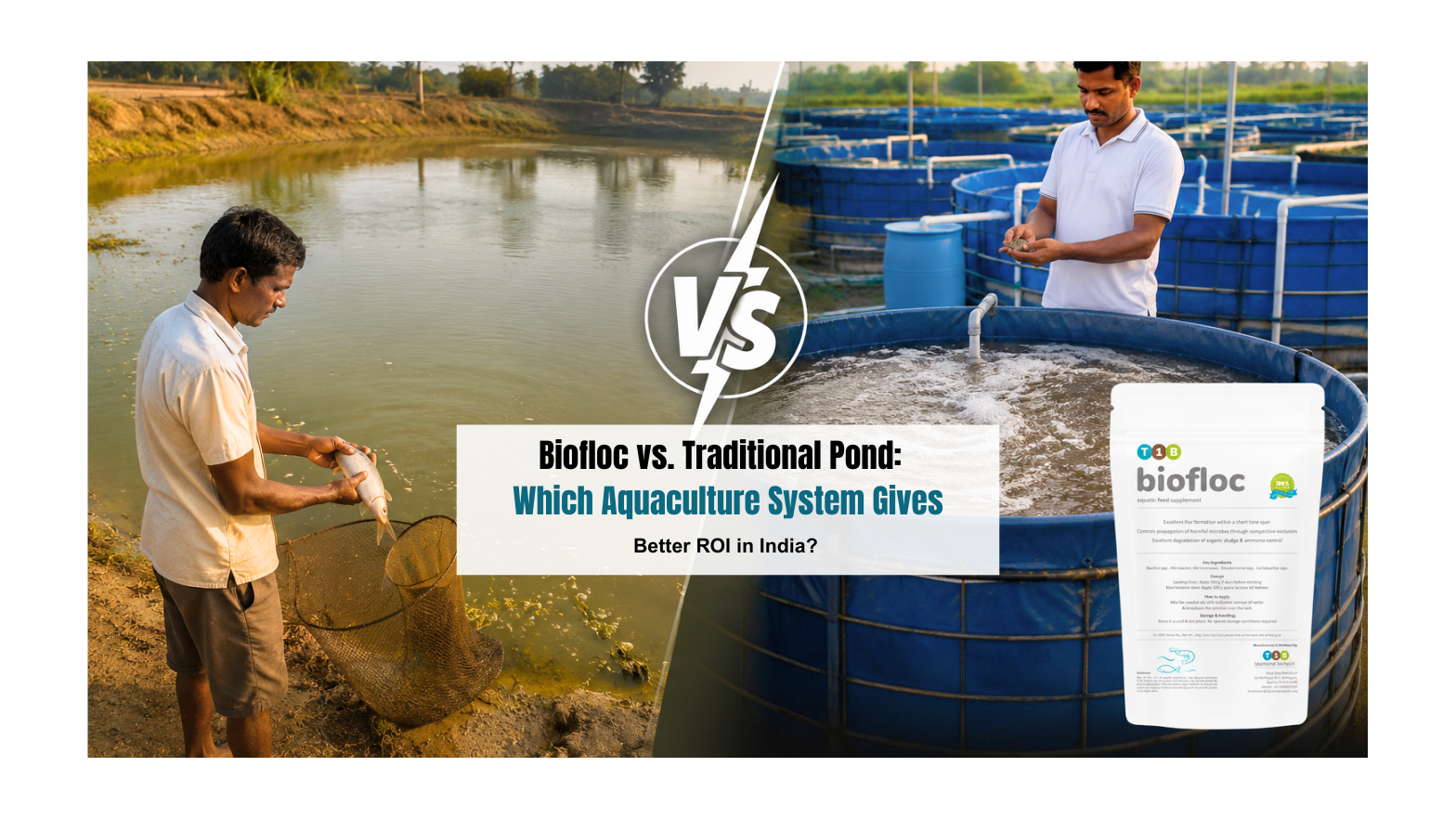

Biofloc vs. Traditional Pond: Which Aquaculture System Gives Better ROI in India?
It is 2 AM. Your farm manager calls. A dissolved oxygen crash has been silently unfolding in your grow-out pond for the past three hours. By morning, you are looking at a partial or total crop loss, weeks of feed investment, fingerling costs, labor, and electricity expenditure wiped out before sunrise. If you farm commercially in India, this scenario is not hypothetical. It is a recurring nightmare that has ended the profitability of operations far larger than yours.
This is the defining tension in modern Indian aquaculture: the gap between what a system promises on paper and what it actually delivers when monsoon salinity shifts, summer temperatures spike, or a Vibrio outbreak moves silently through an unmanaged pond bottom. The choice between a biofloc system vs traditional pond is not merely a technical preference, it is a capital allocation decision with direct consequences on your farm’s survival and long-term ROI.
Let us break both systems down, honestly, with the operational granularity that Indian commercial fish farming demands.
Decoding the Traditional Pond Model
For decades, the earthen pond has been the backbone of commercial fish farming in India, from IMC culture in West Bengal and Odisha to Pangasius grow-out operations in Andhra Pradesh. Its appeal is straightforward: relatively low upfront infrastructure cost, familiarity, and the capacity to leverage existing land parcels.
But the traditional pond model carries structural vulnerabilities that are becoming harder to ignore at commercial scale.
The Land and Water Equation
Traditional pond systems operate at comparatively low stocking densities to manage nitrogen loading, which means significant land area is required to generate commercially viable biomass. As land values rise across coastal Andhra Pradesh, Kerala, and West Bengal’s aquaculture belts, and as groundwater tables fall in states like Gujarat and Karnataka due to seasonal depletion and over-extraction, the cost base of the traditional model is quietly inflating.
Water exchange, the traditional pond’s primary water quality management tool, becomes problematic in regions facing regulatory scrutiny on effluent discharge and in areas where freshwater access is constrained during lean seasons.
The Bottom Sludge Problem
Organic sludge accumulation on pond bottoms is one of the most underestimated threats in traditional aquaculture. In high-temperature Indian summers, accumulated sludge becomes an active site of anaerobic decomposition, producing hydrogen sulphide, triggering ammonia spikes, and creating hypoxic zones that stress or kill bottom-feeding species. Pond bioremediation using specialized microbial consortia is now considered a non-negotiable operational input in well-managed traditional systems, not an optional supplement.
If your traditional ponds are showing early signs of bottom sludge stress, foul odor, surface scum, erratic dissolved oxygen patterns, Team One Biotech’s pond bioremediation protocols are designed specifically for Indian summer and monsoon conditions. Contact us for a water quality audit tailored to your farm.
The Biofloc Paradigm Shift
Biofloc technology (BFT) represents a fundamentally different philosophy of aquaculture water quality management. Instead of diluting nitrogenous waste through water exchange, biofloc systems engineer a controlled microbial ecosystem within the culture tank itself.
By maintaining a precise carbon-to-nitrogen (C:N) ratio, typically achieved by adding carbon sources like molasses or tapioca, heterotrophic bacteria assimilate toxic ammonia and nitrite into microbial biomass. This biomass forms visible aggregates, the “floc”, which aquatic species actively consume, effectively turning waste conversion into a secondary protein feed source.
The implications for high-density fish farming are significant: ammonia stays below toxic thresholds without water exchange, stocking densities can be pushed substantially higher than traditional ponds allow, and the system essentially recycles its own nutrient load.
The challenge, however, is that this microbial equilibrium is not self-sustaining. It demands continuous mechanical aeration, consistent monitoring, and, critically, the right microbial inoculants to establish and maintain floc quality.
The Ultimate ROI Showdown
CapEx and OpEx Breakdown
Traditional Pond:
- Lower initial construction cost per unit area
- Significant land acquisition cost in established aquaculture zones
- Lower power consumption, but high water procurement costs in drought-prone regions
- Periodic pond preparation (liming, drying, tilling) adds to per-cycle operational costs
Biofloc System:
- Higher CapEx: lined tanks or lined ponds, aeration grid infrastructure, power backup (generator or inverter) are non-negotiable
- Electricity costs represent a substantial and continuous OpEx component, a material concern given India’s variable industrial power tariffs
- Lower water consumption and near-zero water exchange once the system stabilizes
- Bio-input costs (carbon sources, probiotics, mineral supplements) are recurring but predictable
Note: These figures represent general industry ranges; operational and financial outcomes will vary depending on local water parameters, species selection, feed management, and individual farm design.
Feed Conversion Ratio and Survival Rates
In biofloc systems, the live microbial floc consumed by fish and shrimp contributes meaningfully to daily protein intake, which in well-managed systems translates to an FCR improvement within a range that meaningfully reduces feed expenditure per kilogram of biomass produced. For species like Vannamei and Tilapia, FCR ranges in optimized biofloc systems tend to fall at the lower end of what is achievable in traditional pond culture.
Survival rates in biofloc systems, when managed correctly, benefit from the reduced pathogen load, controlled environment, and superior water quality. In traditional ponds, survival is more directly correlated with seasonal variability, monsoon-driven water quality fluctuations, and the efficacy of the pond bioremediation strategy employed.
The feed savings potential of biofloc technology is real, but only when the microbial foundation is correctly established and maintained. Team One Biotech’s T1B™ Bio Floc is engineered precisely for this. Ask our specialists how it integrates into your planned biofloc setup.
Note: These figures represent general industry ranges; operational and financial outcomes will vary depending on local water parameters, species selection, feed management, and individual farm design.
Head-to-Head Comparison: Biofloc vs Traditional Pond
| Parameter | Biofloc System | Traditional Pond |
| Land Requirement | Low to moderate (high-density tanks) | High (extensive land area) |
| Stocking Density Range | High to very high | Low to moderate |
| Water Exchange Frequency | Near zero to minimal | Frequent (routine management tool) |
| Ammonia Management | Microbial assimilation (C:N control) | Dilution via water exchange + bioremediation |
| Biosecurity Control | High (enclosed, controlled environment) | Moderate to low (open, weather-dependent) |
| Power Dependency | Very high (continuous aeration critical) | Low to moderate |
| Sludge/Effluent Risk | Moderate (concentrated, managed discharge at harvest) | High (diffuse, seasonal) |
| Feed Cost Efficiency | Higher (floc as supplemental feed) | Moderate (no supplemental feed from system) |
| Climate Sensitivity | Moderate (manageable with backup systems) | High (monsoon/summer fluctuations) |
| ROI Timeline | Faster per crop cycle (smaller land, higher yield) | Slower (land-intensive, lower density) |
| Primary Risk Profile | DO crash, power failure, microbial imbalance | Disease outbreak, sludge toxicity, water scarcity |
Note: Effluent treatment values and discharge standards are general benchmarks and will differ based on the specific layout and design of individual localized Effluent Treatment Plants (ETPs) or settling ponds.
Species-Specific Suitability Under Indian Conditions
Litopenaeus vannamei (Whiteleg Shrimp): Biofloc is increasingly the preferred system for intensive Vannamei culture in coastal Andhra Pradesh and Odisha. The zero-water-exchange design reduces WSSV and EHP introduction risk from untreated water sources, a critical biosecurity advantage. Traditional pond Vannamei culture remains viable but demands rigorous pond bioremediation protocols, especially post-monsoon when organic load spikes.
Tilapia: Tilapia is arguably the most biofloc-compatible species in the Indian context. Its tolerance for variable water quality, omnivorous feeding behavior (meaning direct floc consumption), and fast growth rate make it ideal for high-density fish farming in biofloc tanks. Farmers in inland states like Madhya Pradesh, Uttar Pradesh, and Chhattisgarh are increasingly adopting biofloc-based Tilapia systems where land is available but water is scarce.
Pangasius: Large-scale Pangasius culture in India has historically favored traditional flow-through pond systems in Andhra Pradesh, given the species’ relatively hardy nature. However, as stocking intensities increase and bottom-sludge toxicity becomes a limiting factor, microbial management, both in traditional bioremediation applications and exploratory biofloc setups, is gaining traction.
Indian Major Carps (IMC): Traditional pond culture remains dominant for IMC due to established infrastructure and market channels. Here, the priority ROI intervention is not system conversion, but aggressive pond bioremediation to reduce mortality events and improve growth uniformity.
Biosecurity and the Role of Advanced Bio-Inputs
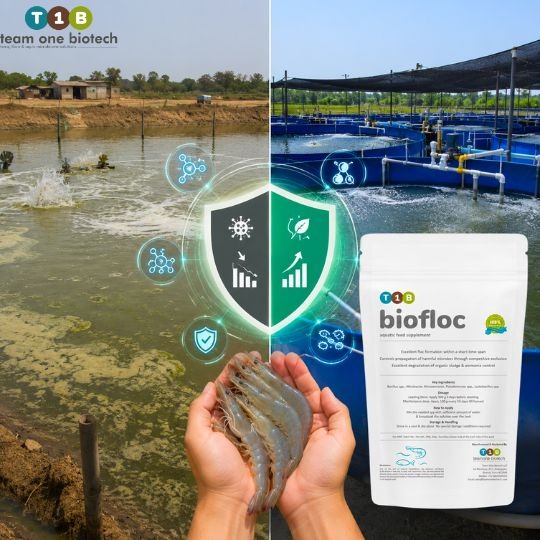
The differentiating factor between a biofloc system that generates strong returns and one that crashes within weeks is microbial management, specifically, the quality and diversity of the probiotic inoculant used to establish and sustain the floc community.
T1B™ Bio Floc by Team One Biotech is a specialized bio-accelerator formulated for precisely this purpose. Derived from natural vegetable sources through controlled fermentation technology, it delivers a minimum bacterial count of 3 × 10⁹ CFU/g in a stable, free-flowing powder form, pH stable between 4 and 9, and temperature stable from 4°C to 58°C, making it operationally suitable across India’s wide seasonal range from Himalayan hatcheries to coastal tropical farms.
What makes T1B™ Bio Floc particularly relevant to commercial operators is the breadth of its functional action:
- Accelerates and stabilizes biofloc aggregate formation
- Actively reduces ammonia, nitrite, and hydrogen sulphide, the three primary water quality killers in intensive systems
- Improves intestinal microbial balance in cultured species, directly supporting immunity
- Enhances immune response against pathogenic bacteria including Vibrio species
- Drives measurable improvement in FCR through combined floc nutrition and gut health optimization
- Supports higher survival rates and production uniformity across the crop cycle
- Non-GMO and GRAS-status certified, with a two-year shelf life from manufacturing date
In traditional pond applications, Team One Biotech’s bioremediation solutions address the organic sludge challenge directly, deploying microbial consortia that break down bottom sludge aerobically, reduce hydrogen sulphide generation in Indian summer conditions, and stabilize ammonia levels during critical post-monsoon loading periods.
Both system types, biofloc and traditional pond, become significantly more financially predictable when underpinned by a consistent, science-backed bio-input program.
Making the Right Investment Decision
There is no universally superior system. The biofloc system vs traditional pond debate resolves differently depending on three variables: the capital available for initial infrastructure, the species and market the farmer is targeting, and the geographic and climatic realities of the farm location.
Biofloc delivers a compelling ROI case for intensive Vannamei and Tilapia operations where land is limited, water is scarce, and biosecurity is paramount. Its weakness lies in power dependency and the technical discipline required to manage microbial equilibrium, both challenges that are solvable with the right bio-input partners and backup infrastructure.
Traditional pond systems remain economically relevant, particularly for IMC, Pangasius, and polyculture operations, but their ROI in the current Indian environment is under sustained pressure from land costs, water scarcity, and the mounting cost of disease events. The answer for traditional pond operators is not abandonment of the model, but systematic intensification backed by professional bioremediation protocols.
In both cases, the margin between profit and loss increasingly lies not in the tank design, but in the microbial management strategy behind it.
Ready to Build a More Profitable, Resilient Aquaculture Operation?
Whether you are evaluating your first biofloc installation, managing a multi-pond traditional farm, or looking to reduce FCR and disease pressure across your existing crop cycles, Team One Biotech’s agronomists and aquaculture specialists work with you to build a bio-input protocol specific to your species, system, and local water chemistry.
Contact Team One Biotech today for a customized water quality audit, biofloc establishment protocol, or pond bioremediation assessment. Your next crop cycle is too valuable to manage on guesswork.
Looking to improve your ETP/STP efficiency with the right bioculture?
Talk to our experts at Team One Biotech for customised microbial solutions.
Contact: +91 8855050575
Email: sales@teamonebiotech.com
Visit: www.teamonebiotech.com
Discover More on YouTube – Watch our latest insights & innovations!-
Connect with Us on LinkedIn – Stay updated with expert content & trends!